California Youth Leadership Council Resources

What is a Documentary?
A documentary is a mini-film perfect for students who like to create using computers and multimedia. Students need to write a script and pull together images, videos, and illustrations to create their film.
Rules
General rules for a documentary include:
-
Your documentary must be an original creation
-
Your documentary must correctly portray your historical evidence
-
Your documentary much include your analysis
-
Your documentary must not exceed 10 minutes in length
-
You must have access to all equipment needed to create and run your documentary
Visit the following resources to help create your Documentary!
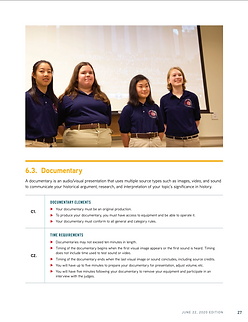
Documentary Rule Book
Documentary Research Organizer
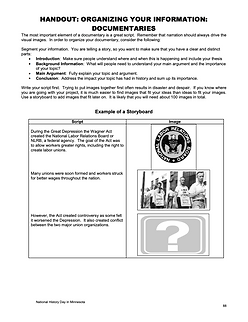
Documentary Judging Rubric

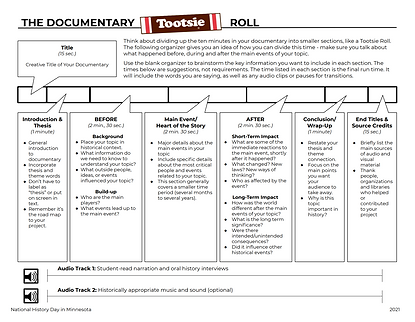
Documentary Tootsie Roll Planning
Documentary Storyboard
Template

Documentary Teacher
Template

Where to Start
A step-to-step guide on how to start creating your documentary!
1. Gather your research - collect your primary and secondary sources needed to get the full picture of your topic. This is where you should become an expert on your topic! Journal, newspaper, and some website articles are a great source of primary sources, and can help give you the perspective of the public's view of your topic! Websites and books are great secondary sources that summarize your topic!
2. Gather your media - collect all the pictures and videos that you will want to use in your documentary! These can include images and videos from the event, of the person, etc. Media often shows while your audio is playing, so make sure that you have plenty of it! Tips: Videos (not images) are often the best form of visuals while audio is playing.
3. Write and revise your thesis - make sure that you have a strong thesis that connects to the theme. After a brief introduction of your topic, your thesis slides will play. Ensure that all topics that you plan to mention in your documentary are mentioned in your thesis! (If you want more information on how to write a strong thesis, click here)
4. Write your script - digitally or physically write out your entire script! This includes what you plan to say in your audios, as well as which pieces of media are going to be shown at which times. Make sure you include your thesis in your script!!! Go into as much detail in your script as needed to ensure that your recording and editing processes go as smoothly as possible.
5. Record your audio - use a reliable recording software to record (and export to your editing software if needed) your audios. Make sure that your voice is steady, and don't talk too fast (play around with your voice to emphasize important parts) to ensure that your audience can make out what you are saying. This part may take a few takes.
6. Edit your documentary - use a reliable editing software to piece together your audio and media. First start our with a general outline of what you want your documentary to look like and the timestamps of each audio/media, then continue to improve the quality (of synced audio to on-screen text, clean transitions between media, etc.).
Sample Documentaries
Tips
1. Use dynamic visuals, not static images
Rely on videos rather than images (for visuals) as much as possible to keep your documentary engaging. When using images, add movement (pan across them, zoom in on details, or highlight key areas) so they don’t feel lifeless.
2. Let visuals share the storytelling
Don’t narrate nonstop. Give your audience breaks by letting clips, images, and ambient audio carry meaning on their own. This makes the documentary feel more alive and professional.
3. Focus on strong research, not flashy editing
Fancy effects aren’t what make a documentary good. Clear analysis, solid evidence, and effective communication matter far more. Overediting can distract viewers from your argument.
4. Actively seek opposing viewpoints
Look for sources that challenge your thesis. If possible, interview someone who disagrees with you; these perspectives deepen your understanding and strengthen your final argument.
5. Choose a local or lesser-known topic
Smaller, local topics often allow for richer research. You’re more likely to access archives, museums, and firsthand interviews, which makes your documentary more original and meaningful.
6. Maintain accurate and engaging visual representation
Use a mix of video clips and images that clearly support what you’re discussing. Visual accuracy helps judges and viewers better understand and remember your argument.
7. Control your pacing and narration speed
Speak clearly; not too fast or too slow. Good pacing keeps viewers engaged without overwhelming or boring them.
8. Use background music intentionally
Music shapes emotion. Avoid using the same track throughout; change music to match different sections so the mood supports your message without overpowering it.
9. Start early and avoid procrastination
Deadlines approach faster than expected. Starting early gives you time to fix pacing, re-record audio, refine visuals, and actually enjoy the process.
10. Track your sources as you research
Keep organized notes and citations from the start. This saves time later and results in stronger annotations, which is something judges notice and value.
11. Keep your thesis sharp and focused
A clear thesis guides every decision. If something doesn’t support it, cut it. A focused thesis makes editing easier and your argument stronger.
12. Balance narration with evidence
Don’t just explain—show. Trust your sources and visuals to demonstrate your points so your depth of research is visible, not just described.
13. Test your documentary with fresh viewers
Show it to people who don’t know your topic. If they can follow your argument and stay engaged, you’re on the right track well before competition day.
Reliable Software
Audio:
- Voice Memos (free for Apple users)
- Audacity (free + cross-platform)
Editing
- Capcut (free with additional upgrade options)
- Adobe Premiere (paid subscription after free trial)
- iMovie (free for Apple users)
- Canva (free with additional upgrade options)