California Youth Leadership Council Resources

What is a Historical Paper?
A historical paper is a written essay for students who like to express their ideas and stories through words. It is the traditional format for presenting historical research. Only Individuals can participate. No groups.
Rules
General rules for a historical paper include:
-
Your paper must be an original creation
-
Your paper must correctly portray your historical evidence
-
Your paper much include your analysis
-
Your paper must be grammatically correct
-
Your paper must be between 1,500 to 2,500 words
Historical Paper Rule Book

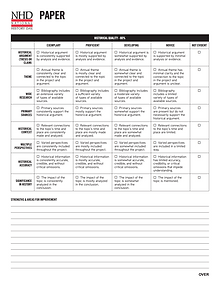
Historical Paper Judging Rubric
Historical Paper Research Organizer

Visit the following resources to help create your Historical Paper!
2025-2026 Historical Paper Timeline
January 20th
February 12th
March 25th
Registration Opens
Registration Closes,
Papers Uploaded
Finalists Announced
April 7th
April 15th
May 1st-3rd
Deadline for Finalists to register for NHD-CA State Contest
Submit Revised Paper for
NHD-CA
NHD-CA Contest at Sacramento State for Top 12 Finalists
*Please note that Historical Papers advance directly to state preliminary judging, and are NOT entered into county level competitions*
For a more in-depth contest timeline, view the NHD-CA website
Where to Start
A step-to-step guide on how to start writing your paper!
1. Gather your research - collect your primary and secondary sources needed to get the full picture of your topic. This is where you should become an expert on your topic! Journal, newspaper, and some website articles are a great source of primary sources, and can help give you the perspective of the public's view of your topic! Websites and books are great secondary sources that summarize your topic!
2. Write and revise your thesis - make sure that you have a strong thesis that connects to the theme. Ensure that all topics that you plan to mention in your paper are mentioned in your thesis! (If you want more information on how to write a strong thesis, click here)
3. Create your drafts - start drafting your paper! Once you finish your first draft, go through and edit any necessary material (ex: incorrect historical evidence/analysis). Continue with editing and rewriting your paper until your paper is ready to submit! It's important to get fresh perspectives from friends, teachers, parents, etc.
Sample Historical Papers
Tips
1. Choose a topic that genuinely interests you.
Select something that aligns with your personal interests or sparks your curiosity so you can write with purpose and keep your paper engaging.
2. Write with intention and engagement.
When you care about your topic, your enthusiasm shows through and helps hold the reader’s attention.
3. Develop your own perspective.
Build a clear, original point of view rather than just summarizing facts or listing events.
4. Create and support a strong argument.
Weave your argument throughout the paper so it drives your narrative and gives your work direction.
5. Focus on originality.
Aim to tell a cohesive story using your own analysis, not just a collection of historical details.
6. Look beyond firsthand accounts when using primary sources.
Primary sources can include people not directly involved in the event, such as journalists, critics, or observers.
7. Use outsider perspectives to deepen your analysis.
External commentators often offer unique insights that may not appear in firsthand accounts.
8. Gather inspiration/read into different creative paper types. (ex: journal entries)